Every country argues about different things.
Every country has the same problems.
- Immigration.
- Global warming.
- Economy and jobs.
- Poverty and homelessness.
Change the language, the flag, the election. The list does not change.
So the question is fair:
Is there any savior solution for the world?
Let's put every option on the table and look at it honestly.
Four Problems, One Root
They look like four problems. They are mostly one.
Immigration. Outside of conflicts, mass migration always moves in the same direction: toward a richer or more generous country. Never the reverse. People do not leave a stable life. They leave a currency that lost its value and a job market that has none.
Global warming. The fight is no longer only about reducing emissions. We are struggling to reduce them. So we also have to clean: air, water, soil. Cleaning is an emerging industry. It is expensive. It has almost no financial return. Nobody is its customer.
Economy and jobs. Work is financed by money. When money is scarce, useful work stops — not because the work is useless, but because the budget is exhausted. Weak-currency countries borrow in strong currencies and pay twice: the interest, plus the devaluation.
Poverty and homelessness. Wealth is defined by humans, for humans. Yet we have built a system where rebalancing wealth means taking it from someone. Historically, that ends badly.
The common root is simple to state:
Money is a reward and a means. Our money is scarce by design, competitive by design, and blind to anything with no return on investment.
Any savior solution has to pass four tests:
- Can it finance work that has no financial return?
- Can it work across borders without a country losing sovereignty?
- Does it fix an imbalance without creating a new one somewhere else?
- Does it stop sending the bill to the next generation?
Now the options.
Option 1: Politics and Government
The default answer. The one we vote for.
What governments do well:
- Laws, courts, police, borders.
- Taxes and redistribution inside their territory.
- Large infrastructure.
- Emergency response.
Where they hit the wall:
- They stop at the border. Immigration, climate and currency flows do not.
- They compete. A government's first duty is its own citizens. A very successful country attracts immigration, pulls investment away from others and devalues their currencies. The leading-country model creates the very imbalance it is supposed to solve.
- They will never adopt another central bank's currency. Sovereignty comes first. So there is no world currency and there will not be one.
- They borrow. Public debt now exceeds the size of most economies. Climate inaction today is billed to people who cannot vote yet.
- They think in election cycles. Cleaning the ocean pays back in forty years. The next election is in four.
Governments are necessary. They are not sufficient. And a government that solves everything for its own people usually exports the problem to its neighbors.
Score: strong inside borders, structurally unable to solve a borderless problem.
Option 2: Corporations
The most powerful machines ever built for turning capital into results.
What corporations do well:
- Scale. Fast.
- Innovation when there is a market.
- Efficiency under competition.
- Jobs, where profit allows it.
Where they hit the wall:
- Return on investment is the rule. Not a preference. A legal duty to shareholders.
- Cleaning has no customer. Nobody pays a company to remove plastic from a river they do not own.
- Pollution is an invisible line item. The cost sits on nobody's balance sheet, so it is nobody's problem.
- They follow strong currencies. Capital moves to where it earns more. That is the same one-way flow that drives migration.
- Philanthropy is a rounding error. Generous, sometimes. Structural, never.
A corporation that spent its capital on restoration with no return would be replaced by one that did not. That is not evil. That is the design.
Score: unbeatable when a market exists, absent when it does not.
Option 3: Community and Groups
NGOs, cooperatives, mutual aid, religious groups, local associations.
What communities do well:
- They are on the ground. They see the real problem first.
- They act where governments are absent and corporations see no market.
- They move faster than both.
- They do not need a return on investment.
Where they hit the wall:
- Scale. A food bank feeds a city. It does not fix the reason the city is hungry.
- Funding. Donations, grants, volunteers. All of it is existing wealth, shared. The pool is finite and it shrinks exactly when it is most needed.
- Dependency. The donor's priorities become the community's priorities.
- Fragmentation. Thousands of groups, thousands of causes, no common unit.
Communities are the most honest actor on this list. They are also the poorest.
Score: right place, right intentions, no financing capacity.
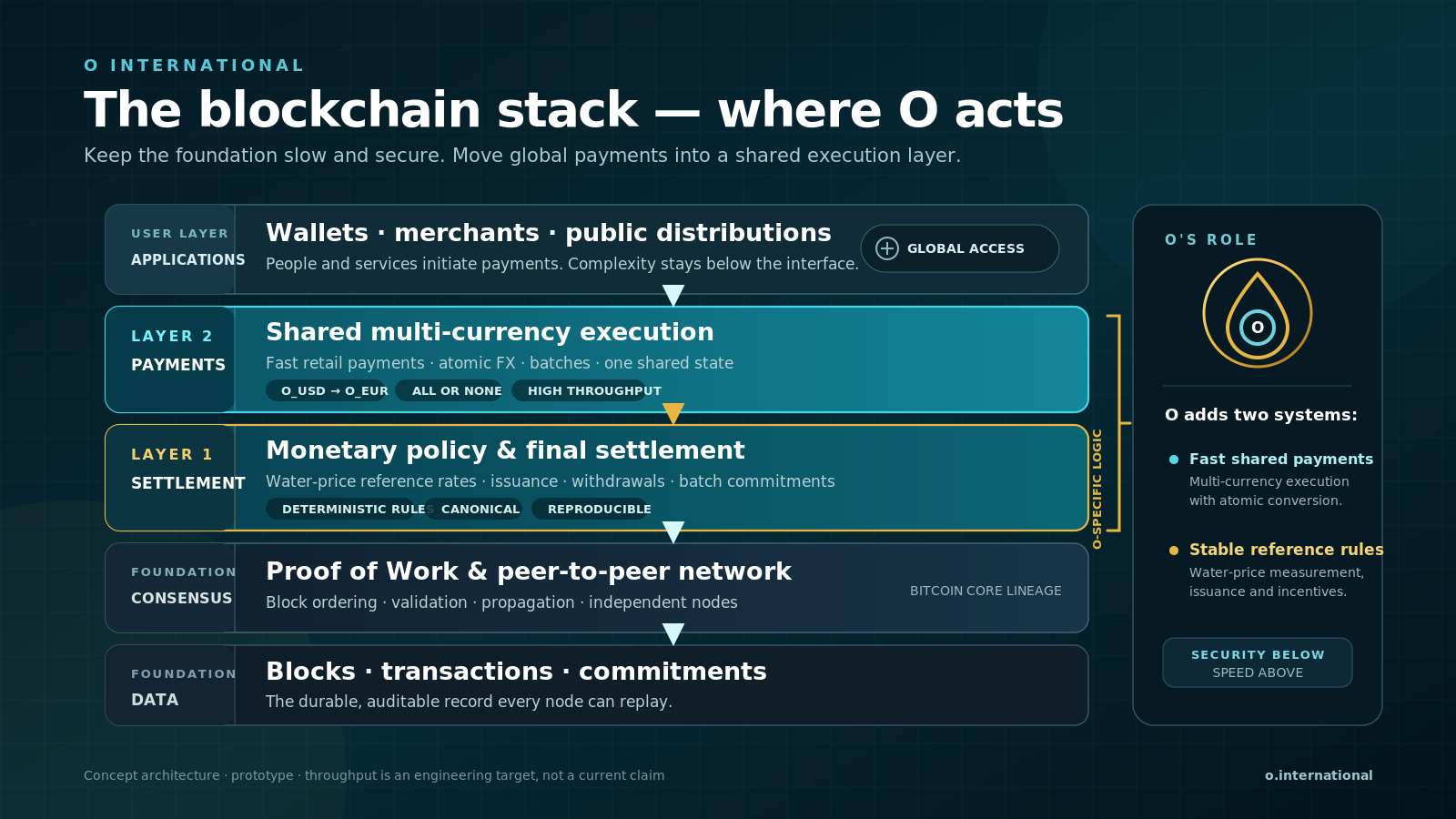
Option 4: A New Kind of Money — the O Blockchain
Notice what the first three options share.
They all spend the same money. Scarce, competitive, borrowed, blind to anything without return.
The fourth option does not replace governments, corporations or communities.
It changes the money they use for the problems none of them can finance.
What O proposes:
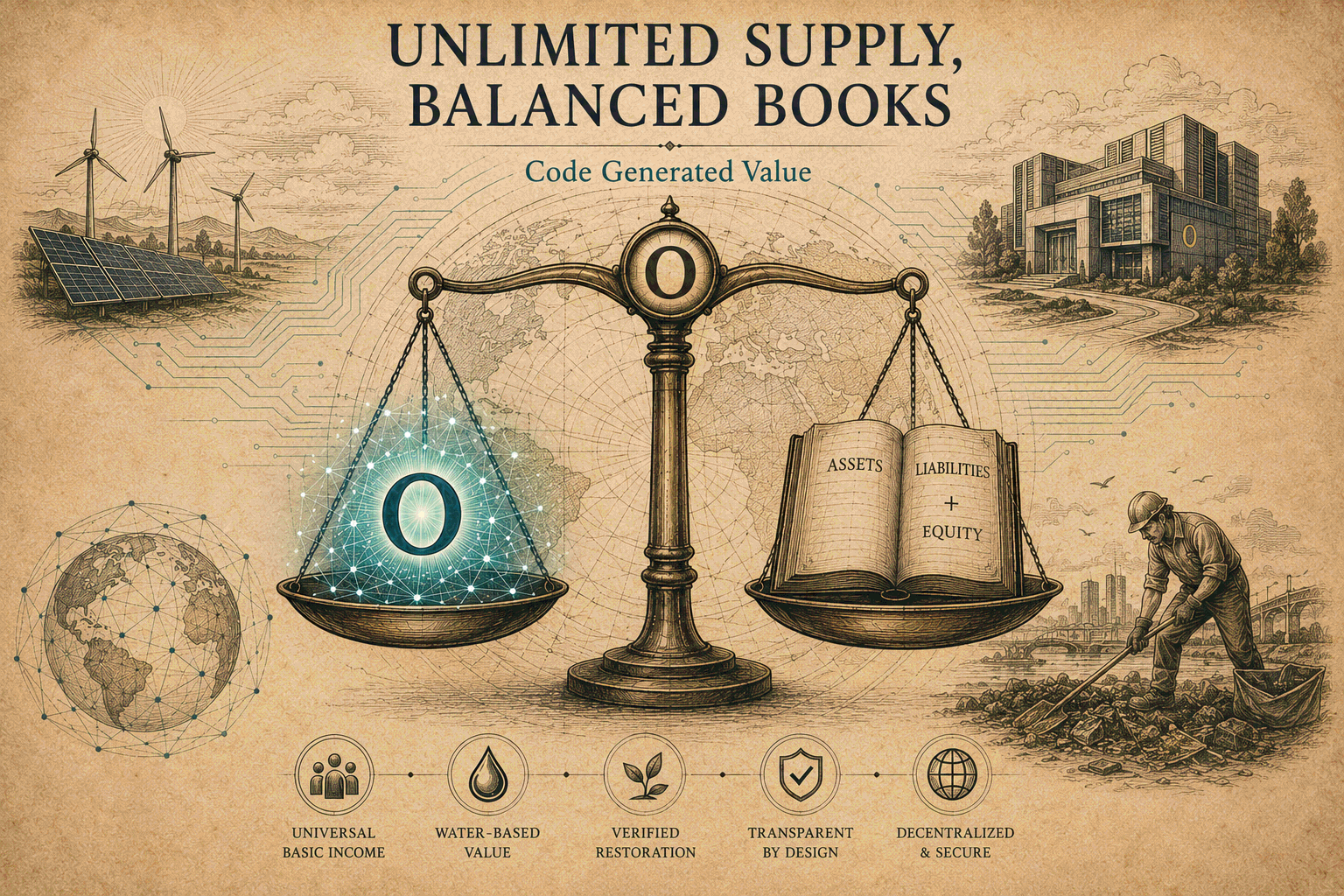
- A stable unit everyone shares. 1 O = the local price of one liter of potable water. Water is the one valuable thing all humans have in common. 142 local O-currencies, one per fiat currency, so no country adopts anyone else's money.
- Unlimited supply, not backed by any asset. Nothing physical is infinite. So the value is calibrated on a price, not on a vault. Stability is enforced by incentives: when a currency drifts from its water price, new coins go to those who stayed stable and dilute those who did not.
- New wealth, not shared wealth. Rebalancing has always meant taking from someone. Open-ended issuance with transparent goals means creating, not confiscating.
- A Universal Basic Income calibrated on water, paid directly, debt-free, to every verified human. That removes the first reason people cross a border.
- Financing for work with no ROI. Verified cleaning of air, water and soil becomes a creation event. The planet gets a customer.
- No debt to the next generation. Nothing is borrowed. Nothing accrues interest.
- Open-source, nonprofit, no one to trust. Code anyone can read, run and fork.
Against the four tests:
- No-ROI work? Yes — that is what it is built for.
- Across borders without losing sovereignty? Yes — one O per local currency, no central bank, no leading country.
- Fixes imbalance without creating a new one? Yes, by design — stability is rewarded everywhere, not in one place.
- Stops billing the next generation? Yes — issuance, not debt.
Where it hits the wall — honestly:
- It is a prototype. The claims must be proven in code, tests and operation.
- It needs reliable water-price measurements and real participation.
- It needs humans to accept a new definition of value. That is the hardest part.
Score: the only option that passes all four tests on paper. None of them are passed in practice yet.
The Scorecard
| Government | Corporations | Communities | O blockchain | |
|---|---|---|---|---|
| Finances no-ROI work | Partly, by debt | No | Yes, until donations run out | Yes, by design |
| Works across borders | No | Yes, toward profit | Partly | Yes |
| Preserves sovereignty | Yes | — | Yes | Yes, local currencies |
| Avoids creating new imbalance | No | No | Yes | Yes, by design |
| Spares the next generation | No | — | Yes | Yes |
| Proven at scale | Yes | Yes | Yes, locally | Not yet |
Read the last line carefully. The three proven options fail the tests. The one that passes the tests is not proven.
That is exactly where we are.
So, Any Savior?
No.
There is no savior solution. There never was. A savior is a leader, and we already wrote about why a leader creates the next imbalance.
What there is, is a missing tool.
- Governments keep their sovereignty and their borders. They get a way to finance what their budgets cannot.
- Corporations keep their ROI. They get a customer for cleaning.
- Communities keep their place on the ground. They get financing capacity that does not depend on a donor's mood.
The first three actors do not need to change. Their money does.
Water is the only thing all of us agree is valuable.
It is a strange place to start a monetary system.
It might be the only place.
The Numbers Behind This Article
- International migrants: 304 million in 2024, nearly double 1990 (UN DESA, International Migrant Stock 2024).
- Remittances to low- and middle-income countries: about $685 billion in 2024 — larger than foreign direct investment and official development aid combined (World Bank / KNOMAD, Dec 2024).
- Global temperature: 2024 was the warmest year on record at about 1.55 °C above pre-industrial levels (WMO, Jan 2025).
- Adaptation finance gap: developing countries need an estimated $187–359 billion per year; international public adaptation finance reached $28 billion in 2022 (UNEP Adaptation Gap Report 2024).
- Extreme poverty: about 808 million people projected to live below the $3.00/day line in 2025, after the World Bank's June 2025 revision (World Bank; UN SDG Report 2025).
- Housing: 1.6 billion people live in inadequate housing; over 1.1 billion in informal settlements and slums (UN-Habitat).
- Global public debt: expected to exceed $100 trillion — about 93 % of world GDP — in 2024 and approach 100 % by 2030 (IMF Fiscal Monitor, Oct 2024).
- Youth unemployment: 12.6 % globally in 2024, versus 5 % overall (ILO, World Employment and Social Outlook: Trends 2025).
- O currencies: 142 local O-currencies covering 195+ countries, each calibrated on the local price of one liter of potable water (o.international).
O International is a nonprofit (association loi 1901). Code is open-source (MIT) on GitHub. Nothing here is for sale — a research/social-good project. Learn more: https://o.international