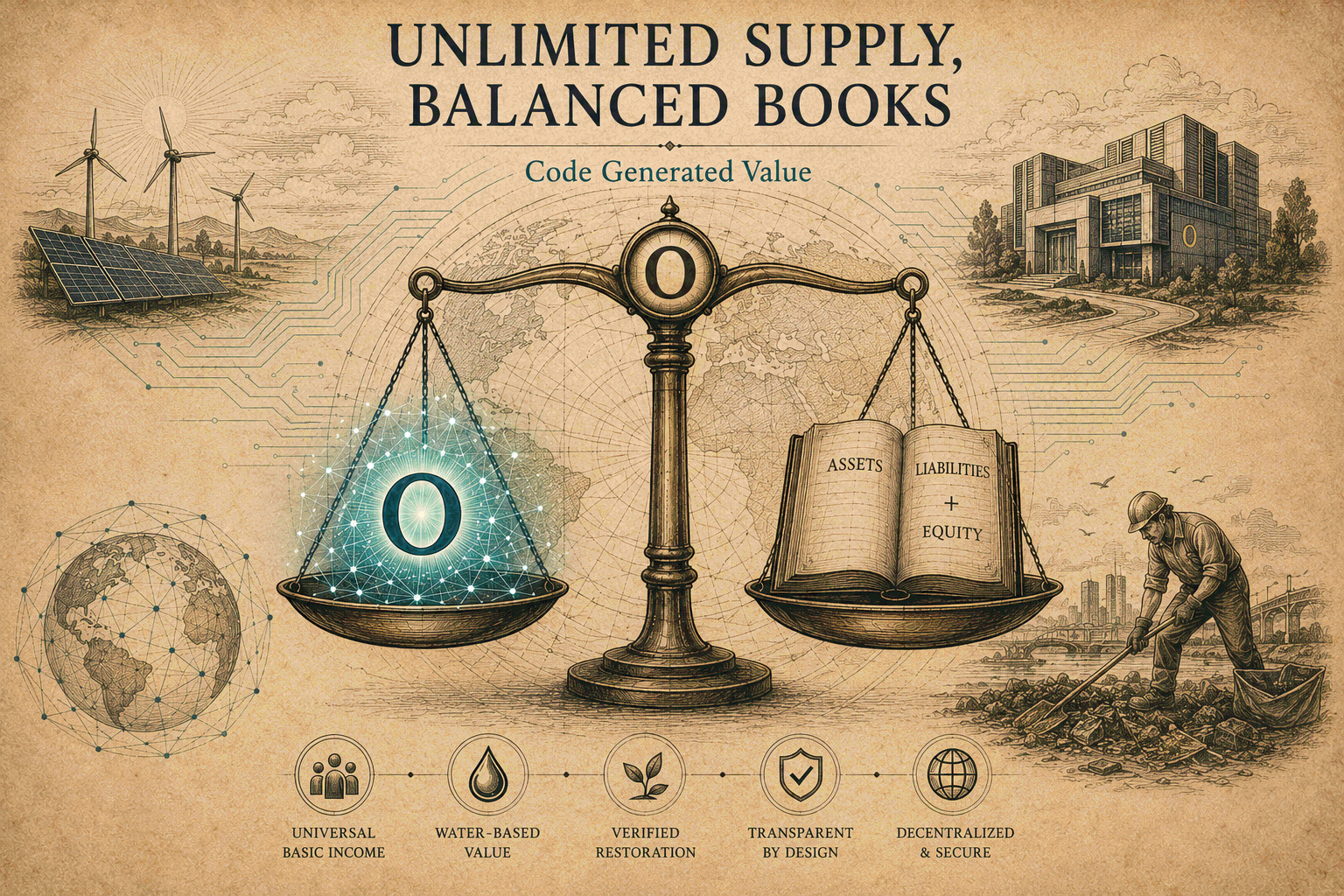
Digital assets introduced something new.
A monetary system no longer needs to fix its total supply in advance. It can create units by rule, without digging them out of the ground and without lending them into existence.
That does not make land, labor, energy or machinery unlimited.
It creates something narrower: open-ended financing capacity.
Useful work no longer has to stop only because a tax budget, lending facility or reserve has been exhausted.
That idea raises an obvious question for accountants:
How can an unlimited currency produce balanced books?
The answer is simpler than it looks.
You do not balance the global supply.
You balance every transaction.
Accounting Was Built in a Physical World
Luca Pacioli published the first widely known description of double-entry bookkeeping in 1494.
Merchants were recording physical commerce:
- cash;
- grain;
- metal;
- land;
- ships;
- goods owed and delivered.
But scarcity is not what makes the books balance.
The books balance because every recognized transaction has corresponding effects. An asset acquired must be matched by income, a liability, another asset surrendered or a change in equity.
The basic equation remains:
Assets = liabilities + equity.
Accounting does not require the total supply of an asset to be limited. It requires each reporting entity to record what it controls, owes, earns and spends.
Then the economy became less physical.
Brands. Software. Patents. Data. Goodwill.
Accounting standards adapted, but intangibles remain difficult to value without a reliable yardstick. Under IAS 38, many internally generated brands, customer lists and similar assets do not appear on the balance sheet at all.
Accounting already knows how to operate in a world where economic value and recorded book value are not identical.
Open-ended digital issuance is another change.
It does not break the accounting equation.
Two Questions, Not One
O separates two questions that are often confused.
The protocol's question: "Should this money exist?"
That breaks down into when new units may be created, why, to whom, and with what protection for the reference value.
Accounting's question: "What does this entity now have?"
That breaks down into what it received, what it controls, what it earned, and what it owes in return.
The first question concerns monetary policy.
The second concerns entity-level records.
They are related. They are not the same.
Under O's proposed design, newly issued O is not a loan to its recipient.
- Nobody borrows it into existence.
- The recipient does not owe it back.
- O International does not promise to redeem every coin for water, fiat currency or another asset.
- Issuance does not require a matching withdrawal from a finite collateral reserve.
That matters.
A unit that carries no contractual redemption right is not automatically the issuer's debt.
Once O reaches a person, company or government, ordinary economic and accounting rules resume.
Where Issuance Goes
O's proposed social issuance has two principal destinations.
1. Universal Basic Income
The design proposes that every verified human receive a basic income calibrated on the local price of potable water.
Not a loan.
Not money collected from another recipient.
A direct protocol distribution.
2. Verified environmental restoration
O could finance work that markets and governments routinely leave undone:
- garbage collected;
- plastics removed from rivers and oceans;
- carbon removed from the atmosphere;
- damaged land and water restored.
Much of this work has a high cost and no conventional return on investment. It is the missing line item we wrote about before (The Invisible Line Item).
The benefit is real. The customer is missing.
O proposes to create the financing when verified restoration occurs.
The protocol also needs operating issuance for network security, measurements and stabilization incentives. Those flows must be explicit, coded and publicly auditable.
There is no blank check.
Money Can Expand. Resources Cannot.
These programs would not be economically invisible.
Cleanup still requires:
- workers;
- machinery;
- transport;
- energy;
- materials.
A global UBI would also change demand.
O does not make those resources unlimited. Its narrower claim is that financing does not need to stop because an existing pool of money has run dry.
That moves the constraint.
Instead of asking only, "Where will the money come from?" we can ask better questions:
- Is the work useful?
- Has it been verified?
- Are the people and physical resources available?
- Can issuance expand without overwhelming productive capacity?
- Does the stabilization mechanism preserve the reference value?
Open-ended financing does not remove discipline. It changes where discipline belongs.
Every Downstream Transaction Still Balances
Suppose a company completes verified cleanup work and receives O.
It records the revenue and the asset received under the accounting standards that apply in its jurisdiction. Classification may depend on how the company holds and uses the coin. The entries still balance.
Suppose the company spends that O on equipment.
It records the equipment acquired and the asset surrendered. Balanced.
Suppose a government receives, spends or distributes O.
It follows its applicable public-sector accounting rules. Balanced.
Suppose O finances activity that a government currently funds, or cannot afford to fund.
That could reduce pressure on a public budget. It is an economic possibility, not an automatic accounting result.
The protocol's supply policy does not suspend entity-level accounting.
The source can remain open-ended while every use remains recorded, classified and auditable.
Unlimited Does Not Mean Uncontrolled
O is not designed for unlimited instant creation.
It is not designed for arbitrary distribution.
- Creation events follow coded rules.
- Distribution categories are defined.
- Issuance occurs through the protocol.
- Transactions remain visible on the shared ledger.
- Participants can audit the resulting supply.
O is designed not to defend its reference value by spending a finite reserve.
Instead, the protocol publishes reference rates calibrated on the local price of one liter of potable water. Participants remain free to trade elsewhere. The incentive mechanism rewards those who remain aligned through relative dilution when others diverge.
No forced exchange rate.
No promise of redemption from a vault.
No collateral reserve that must eventually run out.
That does not remove every dependency. The system still requires:
- reliable price measurements;
- deterministic execution;
- sufficient participation and liquidity;
- transparent issuance;
- an incentive mechanism that works under real market conditions.
O is still a prototype. Those claims must be demonstrated in code, tests and operation.
If Society Still Wants a Ceiling
Programmable money can impose limits that paper money cannot.
Coins could lose value over time through programmed decay or demurrage. They could simply expire. Both are workable. Neither is elegant — someone always eats the loss.
There is a third option, almost inconceivable today: individual wealth, returned at death.
That option deserves its own article.
None is required to solve the accounting question here.
Open-ended protocol issuance can coexist with balanced books without making individual coins expire.
The Books Are Fine
O does not abolish accounting.
The protocol governs creation and distribution.
Accountants record what each entity receives, controls, owes, earns and spends.
Real resources remain scarce. Every use of those resources still carries a cost. Every company and government still has obligations that must be recorded.
But financing capacity does not need to share the same ceiling.
You do not balance the total possibility of creation.
You balance every transaction that follows.
That is not a contradiction.
It is the difference between monetary policy and accounting.
The Numbers Behind This Article
- Double-entry bookkeeping, first published description: Luca Pacioli, Summa de arithmetica, 1494 (ICAEW historical collection; accounting histories).
- Accounting equation: double-entry maintains assets = liabilities + equity by recording corresponding effects for each transaction (standard accounting framework).
- Internally generated intangibles: IAS 38 generally prohibits recognizing internally generated goodwill, brands, mastheads, publishing titles, customer lists and similar items as assets (IFRS Foundation, IAS 38).
- Crypto-asset accounting under IFRS: holdings are generally analyzed under IAS 38 or, for broker-traders in qualifying circumstances, IAS 2 inventory; treatment depends on the facts and purpose of holding (IFRS Interpretations Committee; PwC and EFRAG accounting analyses).
- Plastic entering aquatic ecosystems: approximately 1–2 million tonnes reaches the ocean each year in recent estimates (Our World in Data).
- O currencies: 142 local O-currencies covering 195+ countries, each calibrated on the local price of one liter of potable water (o.international).
O International is a nonprofit (association loi 1901). Code is open-source (MIT) on GitHub. Nothing here is for sale — a research/social-good project. Learn more: https://o.international