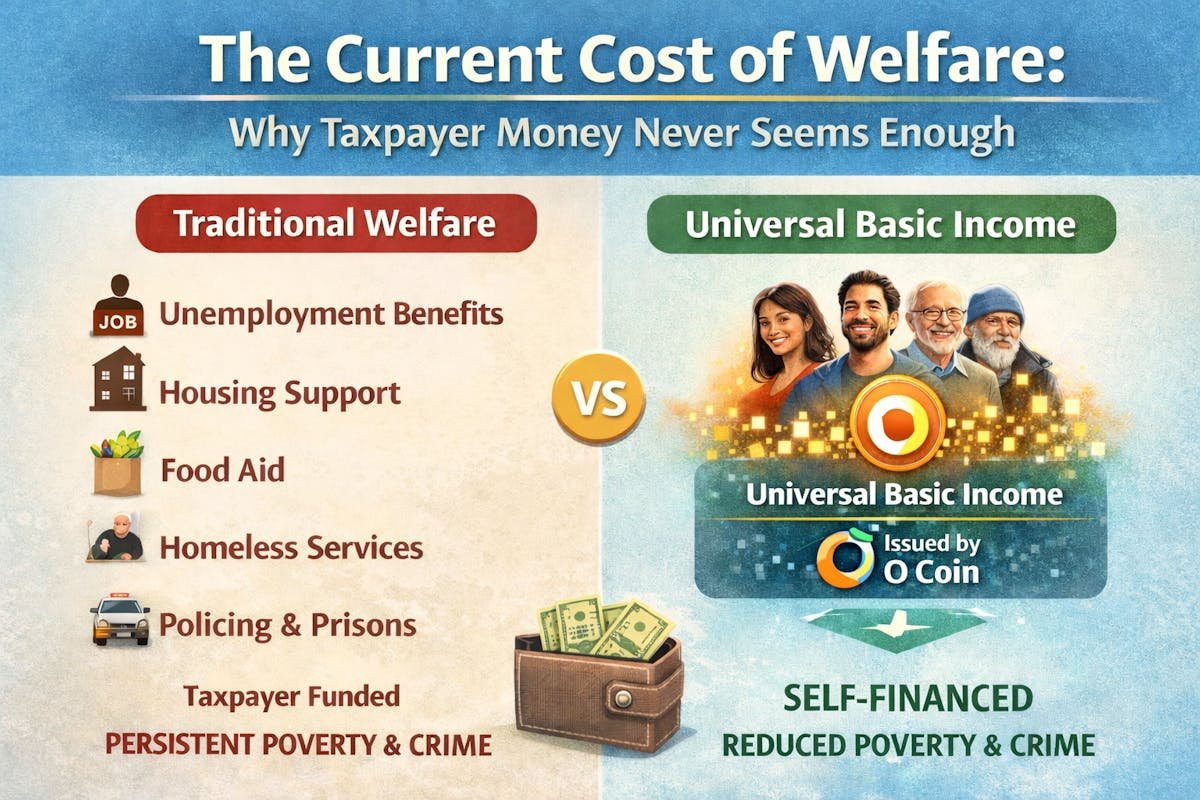
The Current Cost of Welfare: Why Taxpayer Money Never Seems Enough
Today, governments fund a vast patchwork of programs to support people in need:
- Social assistance: Unemployment benefits, housing support, child benefits, disability payments, food programs
- Healthcare subsidies: For those who can't afford care
- Pension top-ups and minimum income for the elderly
- Programs for homeless people: Shelters, outreach, emergency aid
- Criminal justice and delinquency: Policing, courts, probation, prisons—much of which is linked to poverty and lack of options
- Foreign aid and development: Programs to help other countries' populations, often to compensate for inequality and instability that stem from lack of basic security
Each program has its own rules, eligibility criteria, and bureaucracy. Administrative costs eat a significant share of every dollar spent. People fall through the cracks between programs, or get trapped in "benefit cliffs" where earning more means losing support. Taxpayers fund all of it—and still, poverty, homelessness, and delinquency persist.
The result: Government action is spread across dozens of domains. A large share of taxpayer money goes to managing need rather than to things everyone would agree are essential: security, justice, infrastructure, and the rule of law.
What "Self-Financed" UBI Means: No Tax Funding Required
Most UBI proposals assume the state pays for it by taxing more or reallocating existing spending. That keeps the debate stuck on "who pays" and "how much tax."
Self-financed UBI is different. The income is created by the monetary system itself—for example, through algorithmic issuance on a blockchain—rather than by collecting taxes and then redistributing. No increase in taxation is required. No "taking from the rich to give to the poor." The basic income is new money, created for that purpose, and sent directly to people's wallets.
Why this matters for government savings:
- The UBI stream does not depend on the government budget.
- Governments do not need to raise or reallocate taxpayer money to fund this basic security.
- So the question becomes: Once everyone has a basic income, what do governments still need to pay for?
The answer is: far less than today.
Welfare Programs Can Disappear—Replaced by One Transfer
If every person receives a self-financed UBI that covers basic needs:
- Unemployment benefits become less critical—people have a floor while they look for work or retrain.
- Housing support, minimum income, and many family benefits are partly or fully replaced by the fact that everyone already has a base income.
- Complex means-tested programs can be phased out: no more eligibility checks, benefit cliffs, or separate applications for housing, food, and cash.
- Pension top-ups for the poorest retirees matter less when everyone has had a lifetime of UBI and has a basic income in old age.
One unconditional transfer replaces a maze of programs. The administrative cost of "who gets what" collapses. Governments can stop running the machinery of welfare delivery and stop spending taxpayer money on it.
Effect: Social welfare as we know it can disappear—not because we abandon people in need, but because need is addressed by a universal floor that doesn't depend on the state's budget.
Less Poverty and Homelessness, Far Less Delinquency
Poverty and homelessness are among the strongest drivers of delinquency and crime. People without security or options are more likely to end up in the justice system—and once inside, reintegration is harder without a basic income.
With self-financed UBI:
- Fewer people are destitute or homeless, so fewer are pushed toward survival crime or street-level disorder.
- Fewer people need to be policed, prosecuted, and imprisoned for offenses that are tightly linked to economic desperation.
- Reentry becomes easier: everyone has a minimal income, so ex-offenders are not released into zero income and immediate pressure to reoffend.
Government savings:
- Less demand for policing focused on poverty-related crime
- Fewer court cases and probation caseloads
- Smaller prison populations and lower spending on incarceration
- Less spending on emergency shelters, outreach, and crisis services tied to homelessness
Delinquency does not disappear, but a large share of it is poverty-related. Remove the poverty, and the need for taxpayer-funded "remediation" drops. Government can focus justice spending on what is truly essential: protecting rights and enforcing the rule of law, not managing the consequences of mass economic insecurity.
No Need for Programs to Help Other Countries—At Least Not for Basic Survival
A big part of foreign aid and development is about compensating for the fact that people in many countries lack basic income and security. When currencies are weak, jobs are scarce, or institutions fail, other countries and international bodies step in with aid to prevent famine, disease, and mass migration.
If UBI is universal and self-financed:
- People in every country receive a basic income (e.g. in a universal, stable digital currency).
- Basic needs are met locally; survival is less dependent on external aid.
- Economic migration driven by sheer destitution drops—people don't have to leave to survive.
- Governments can reduce or redirect programs that exist mainly to "help other countries' populations" because those populations are no longer without a floor.
This does not mean all international cooperation disappears. It means the kind of spending that exists only because other people lack basic income can shrink. Taxpayer money no longer has to fill that gap at the same scale. Government action abroad can focus on what is genuinely collective (e.g. climate, health, security) rather than on compensating for the absence of a global basic income.
Government Reduced to What Is Important and Essential
Today, a large share of government action is devoted to:
- Deciding who gets which benefit
- Running welfare, housing, and social services
- Managing the fallout of poverty: crime, homelessness, crisis intervention
- Helping other countries' populations who lack basic security
With a self-financed UBI in place:
- Welfare: Largely replaced by the UBI itself.
- Poverty-related delinquency: Greatly reduced; justice system can focus on core functions.
- Foreign aid for basic survival: Less necessary when people everywhere have a basic income.
What remains as clearly essential?
- Security and defense (to the extent citizens agree it's necessary)
- Rule of law: Courts, law enforcement for serious crime, protection of rights
- Critical infrastructure: Roads, water, energy, communications—where collective provision is needed
- Public goods that cannot be fairly provided by the market alone
That is a much smaller, clearer mandate. Taxpayer money could be limited to funding these essential functions. No need for the vast apparatus of social welfare administration, or for the extra policing and prisons that exist to manage poverty-driven delinquency, or for the scale of foreign aid that compensates for the lack of a global basic income.
Result: Government action shrinks to what is important and essential. Taxpayer funding can be reduced to a strict minimum.
The Self-Financed UBI Mechanism: Why Blockchain Changes the Equation
Traditional money is issued by central banks and governments. Any "UBI" paid in that money has to be funded by taxes or debt—so it's never truly self-financed from the state's point of view.
Blockchain changes that. A protocol can issue a stable digital currency according to transparent rules—for example, pegged to a real-world reference like the price of water—and distribute a basic amount to every human. No government has to collect taxes or run a welfare bureaucracy to fund it. The creation and distribution are built into the system.
O Coin and O Blockchain (https://o.international) are designed for exactly that:
- Self-financed: Algorithmic coin creation without backing; no taxation required.
- Universal: Same basic income for everyone, everywhere, in a stable unit (e.g. water price-based).
- Cost-free for governments: No reallocation of taxpayer money needed to fund the UBI itself.
- Stable and transparent: Value tied to a measurable benchmark (water price), not to a single government or central bank.
So the savings described above are not theoretical. They become possible when UBI is delivered by a system that does not rely on the state's budget. Governments can then genuinely reduce spending to the strict minimum: security, justice, and essential infrastructure.
Conclusion: From Maximum Welfare to Minimum Government
Today, governments spend a large share of taxpayer money on welfare, on managing the effects of poverty (including delinquency), and on helping other countries' populations who lack basic security. That spending is necessary only because we have never had a universal, self-financed basic income.
With a self-financed UBI:
- All social welfare programs can disappear, replaced by one unconditional transfer.
- Delinquency falls as poverty and homelessness fall, cutting the need for policing, courts, and prisons.
- The need for programs to "help other countries" drops when people everywhere have a basic income.
- Government can shrink to what is important and essential—and taxpayer money can be reduced to a strict minimum.
Self-financed UBI does not mean "no government." It means government no longer has to pay for the absence of a basic income. That is the saving. And with blockchain-based systems like O Coin, it is no longer just an idea—it is a design that can make minimal government and maximum security for all the same thing.
References & Further Reading
- Universal Basic Income research (pilot programs, cost analyses)
- Government spending on welfare and administration (OECD, national statistics)
- Poverty, homelessness, and crime (criminological and economic literature)
- O Blockchain: Universal UBI and water price-based currency (https://o.international)
Note on Content: This article examines how a self-financed UBI could reduce government spending and taxpayer burden. It is not advocating for the elimination of all government functions, but for focusing taxpayer money on essential functions once basic security is provided through a universal, non-tax-funded mechanism.