O International - The World's First Water Price-Based Stablecoin

A cryptocurrency system with 142 global currencies, designed to provide stable, universal money for all humanity. O International is a French nonprofit association dedicated to building a water price-based stable cryptocurrency.

Key Features of O Blockchain

Water Price-Based: 1 O equals the average price of 1 liter of water in each currency. Prices measured by bots and randomly picked users in real time, online and offline.

142 Global Currencies: O_USD, O_EUR, O_JPY, and 139 more. One O currency for each national currency covering 195+ countries globally.

Water Price Peg: Each O currency equals 1 liter of water price in its local market. Exchange rates reflect water price ratios. Stability doesn't depend on human trust!

Incentive-Based Stability: Economic incentives through coin creation and dilution force actors to maintain water price-based exchange rates provided by the blockchain.

Unlimited Supply: Not backed by water or any limited resource - calibrated to water price only. Can scale to serve all humanity. Value tied to water price measurement (constant), not scarcity.

Decentralized: Built on Bitcoin Core. No central authority. Community governance. Open source MIT licensed.

How O Blockchain Works

Step 1 - Water Price Measurement & Exchange Rate: Blockchain sends invitations to randomly selected verified users worldwide to measure bottled water prices (0.9-1.1 liter containers) in their local fiat currency along with online bots. Data is captured online through URL or offline with pictures and GPS proof, then validated by human users. The Gaussian average of measurements establishes each O currency's value: if water costs $1.50/L in USD, then 1 O_USD = $1.50. Cross-currency rates are calculated from these values.

Step 2 - Stability Monitoring: Users and online bots are invited to measure the actual exchange rate between O currency and fiat currency (when available). The system compares these observed rates with the theoretical rates from water price measurements. To be stable, the observed exchange rate should equal the measured water price.

Step 3 - Stabilization Through Economic Incentives: When market exchange rates deviate from the theoretical rates (which are the measured water prices), new coins are created and given to stable currency users, diluting unstable currencies. This creates economic pressure to maintain the water price peg. Core principle: the offender's sanction is the reward of the offended.

Step 4 - Mining Rewards: Miners who secure the blockchain receive 700 O coins per block as a reward. This provides the security foundation for the entire system.

Step 5 - Repeat Cycle: The measurement and stabilization process repeats continuously, ensuring each O currency maintains its water price peg through automatic economic incentives.

Global Benefits

Universal Basic Income

O Coin's water price-based stability and unlimited supply could theoretically support Universal Basic Income. By pegging to a basic human need rather than fiat currency, it could provide equal purchasing power globally without inflation. Key benefits include stability based on basic need (water), equal purchasing power for everyone, unlimited supply without debt, and community-governed implementation.

Immigration Impact - Addressing Economic Migration

If UBI were implemented with O Coin, it could theoretically reduce mass immigration by addressing the root cause: economic desperation. By providing economic stability everywhere, people could build prosperity in their home countries. This could lead to economic stability in all countries, reduced incentive for economic migration, local economic development enabled, and potential reverse migration.

Climate Solution - Unlimited Debt-Free Climate Funding

O Coin's unlimited supply could theoretically fund massive climate restoration without debt. Traditional economics can't fund planetary cleanup (no ROI). O Coin could change this by creating money specifically for environmental restoration. Benefits include unlimited funding without creditors, reforestation, ocean cleanup, renewables, local production reduces transportation, and no financial return needed.

About O International

O is an "association de loi 1901", a French nonprofit association based in Côte-d'Or, France. It was created in September 2022 by Christophe Normand and Michel Inacio. Our mission is to design, program, and promote a stable digital coin based on potable water price. Our main source of financing comes from donations from individuals.

Frequently Asked Questions

What is O Blockchain? The O coin is a stable coin based on potable water price, defined as the average value to buy one liter of potable water individually. To avoid entering into the volatile system of supply and demand, the O coin isn't backed by any physical asset allowing unlimited supply and avoiding inventory/price manipulation.

What are the benefits of a water based stable coin? The benefits of a water based currency are huge because its value and stability don't depend on human trust or confidence but on the value of basic human necessities. The coin can be unlimited because it is not backed up by physical assets but based on calibration and real-time user observations.

Is the O coin open source? Yes, the O coin is an open source project for a peer to peer blockchain that doesn't rely on any central authority and with no ownership other than its believers.

Contact: Email support@o.international | GitHub: https://github.com/cno127/o-blockchain | YouTube: https://www.youtube.com/@OInternational | LinkedIn: https://www.linkedin.com/company/o-international

Keywords: O coin, O blockchain, water-based stablecoin, cryptocurrency, universal basic income, UBI, climate finance, stable digital currency, decentralized money, 142 currencies, bitcoin fork, water price peg, economic stability, French nonprofit, open source blockchain, MIT license

All Articles
Economic Philosophy

ROI Can’t Save Us: Why Today’s Money Fails at Humanity’s Biggest Problems

November 21, 2025·O International
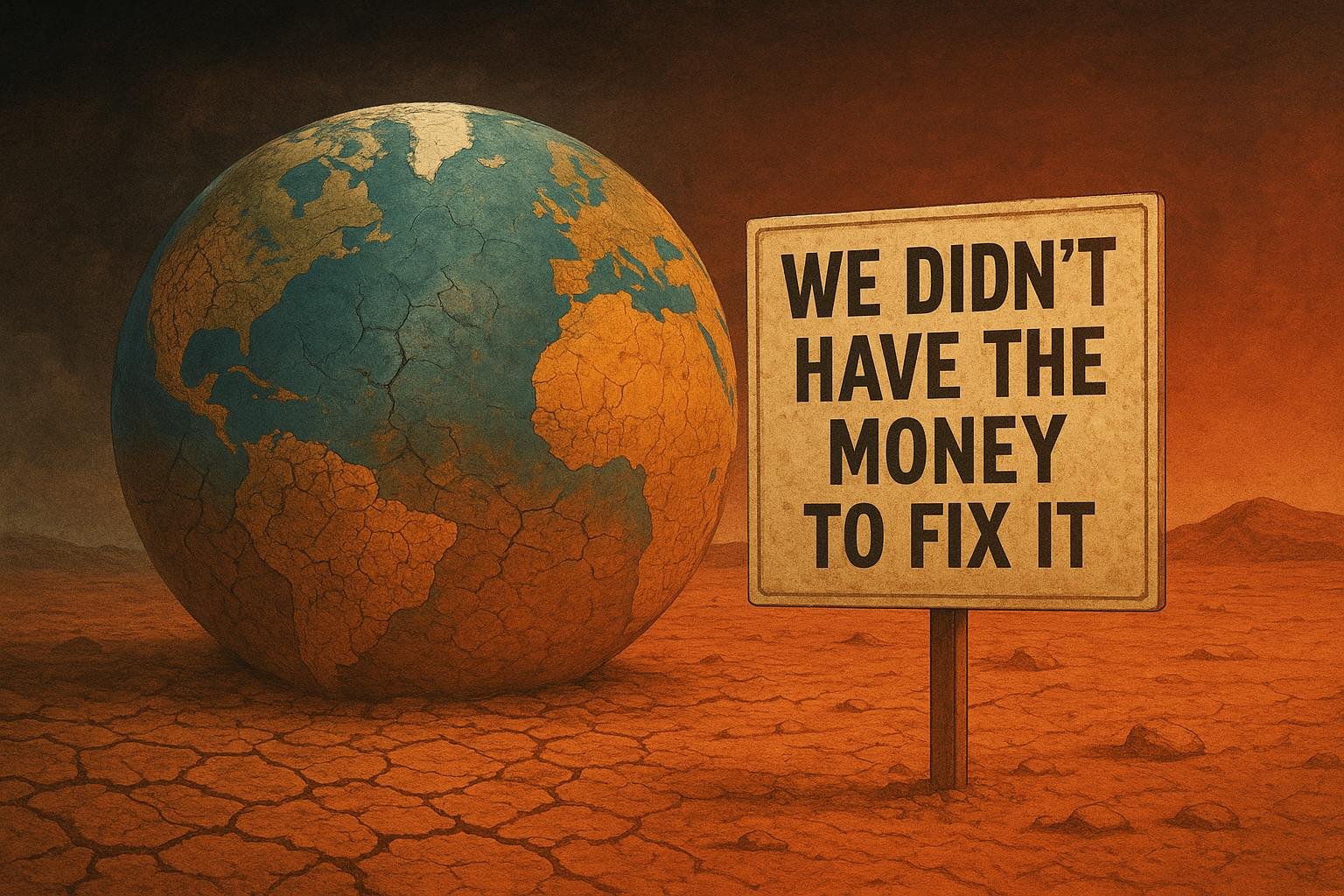
A cracked Earth globe on parched ground with a sign reading 'WE DIDN'T HAVE THE MONEY TO FIX IT'.

TL;DR — We don’t lack ideas or tools to clean up; we lack a monetary logic that funds non-ROI necessities at planetary scale. If we keep asking capital markets to solve problems that don’t return capital, we will keep getting underinvestment. The path forward is to redefine what we’re willing—and able—to finance, with mechanisms built for public goods rather than profits alone.

Modern economy funds what returns capital. That’s efficient for many things—until the necessary work is unprofitable. Cleaning our air, water, and soil is a prime example: pollution has been a by-product of profitable activity; cleaning it is usually a cost center. We now face a paradox: problems we must solve to survive don’t generate the “value” our system recognizes.

What “Cleaning the Planet” Really Means

  • Earth cleaning is the reverse of polluting: removing particles and trash accumulated over decades in air, waters, and soil, and it should be, in all logic, the #1 industry in the future
  • It’s not optional. If regulators are struggling to reduce emissions fast enough, we must also accelerate cleaning to offset damage already done.
  • It’s expensive, slow to monetize, and hard to collateralize. That’s why it struggles to attract capital at the scale and speed required.

What We’ve Tried (and Why It’s Not Enough)

  • Carbon taxes and credits can help, but global alignment is unlikely in time, and taxes don’t automatically turn problems into solutions.
  • Philanthropy and mindful companies do important work, but their budgets and mandates are limited.
  • “Make cleaning profitable” is more slogan than plan. Some business models exist (e.g., CO2 capture with resale, ocean plastics upcycling), but many cleaning tasks have no market buyer.

The ROI(Return On Investment) Constraint

Capital markets optimize for return. Governments also rely on tax revenues and debt markets—both ultimately sensitive to growth forecasts and interest costs. When a vital activity has a weak or negative ROI, it loses in budget prioritization against activities that promise growth. That logic is coherent internally—but existentially misaligned with planetary needs.

Examples of Non-ROI Vital Work

- Industrial-scale particulate removal from air over megacities.

- River, ocean, and microplastic cleanup at the source and at scale.

- Soil remediation for heavy metals and chemical runoff.

- Global reforestation where land-use economics are unfavorable.

- Reshoring/nearshoring essential industries to reduce freight emissions where no clean immediate substitute exists for heavy transportation.

Why the Current Monetary System Struggles

- It rations funding through profitability filters and risk premiums.

- It treats many forms of cleaning as “costs,” not “assets” that generate cashflows.

- It requires political coordination for public-good spending that is slow and polarizing across borders.

- Currency competitiveness—each jurisdiction having its own cost of capital and trade—discourages unilateral spending on non-ROI global goods.

What a Fix Would Require (Design Principles)

- Abundant, stable funding for activities with low or negative ROI but high social impact.

- Programmatic transparency so the public and regulators can verify how funds are used and what impact they produce.

- Global interoperability so cleaning projects can be financed where they are most effective, not just where capital is cheapest.

- Governance that can prioritize public goods without hinging on short-term profit cycles.

A Proposal to Consider: Financing Non-ROI Essentials with Programmable Money

The O project proposes a monetary instrument designed to fill this gap.

Conceptually:

  • Unlimited yet stable medium: elastic issuance to match need, with stability rules independent of human confidence cycles. Funding subject to performance and deliveries.
  • No creditor overhang: fund public-good tasks without debt-service constraints that crowd out operations.
  • Programmatic guardrails: real-time attestations, proof-of-liabilities, open dashboards, and policy hooks for regulators.
  • Target use case: finance earth cleaning—air, water, and soil—at scales capital markets won’t touch due to weak ROI, plus strategic relocation of industries closer to customers to cut freight emissions.

Why are we touting unlimited supply and stability together?

Unlimited without stability is inflationary chaos. Stability without elasticity starves essential work. The premise is to maintain price stability through transparent, rule-based mechanisms while allowing supply to expand specifically into audited, non-ROI vital activities. Think stable purchasing power plus issuance tied to verifiable public-good outputs (e.g., tons of CO2 captured, hectares of soil remediated, kilometers of river cleaned).

Safeguards You’d Expect

- Transparent governance with multi-party controls.

- Redundant oracles and continuous audits.

- Public impact metrics per funded project and performance monitoring.

- Clear on/off policy levers so supervisors can intervene if metrics drift or abuse occurs.

What This Enables

- Large-scale cleaning programs that don’t rely on fragile business models.

- Faster deployment where the marginal benefit is highest, irrespective of local tax capacity.

- A way to fund shared survival tasks even when traditional ROI is absent.

What to Do Today

- Support and scale existing cleaning tech: CO2 capture, ocean cleanup, soil remediation.

- Back nonprofits already doing the hard work on rivers, oceans, air, and soil.

- Encourage industry relocation closer to customers where feasible to reduce high-emission freight.

- Push for radical transparency: real-time reporting on environmental spending and outcomes. Public Transparency.

- Support our non-profit, O International, for the creation of a stable digital currency ecosystem based on global water prices. https://o.international

We don’t lack ideas or tools to clean up; we lack a monetary logic that funds non-ROI necessities at a planetary scale. If we keep asking capital markets to solve problems that don’t return capital, we will keep getting underinvestment. The path forward is to redefine what we’re willing—and able—to finance, with mechanisms built for public goods rather than profits alone.

Note: This is a design space; O coin is one proposed approach—not investment advice.

Learn more on how a stable coin based on global water price can resolve all those issues very quickly at https://o.international


Originally published by O International on HackerNoon. View the original