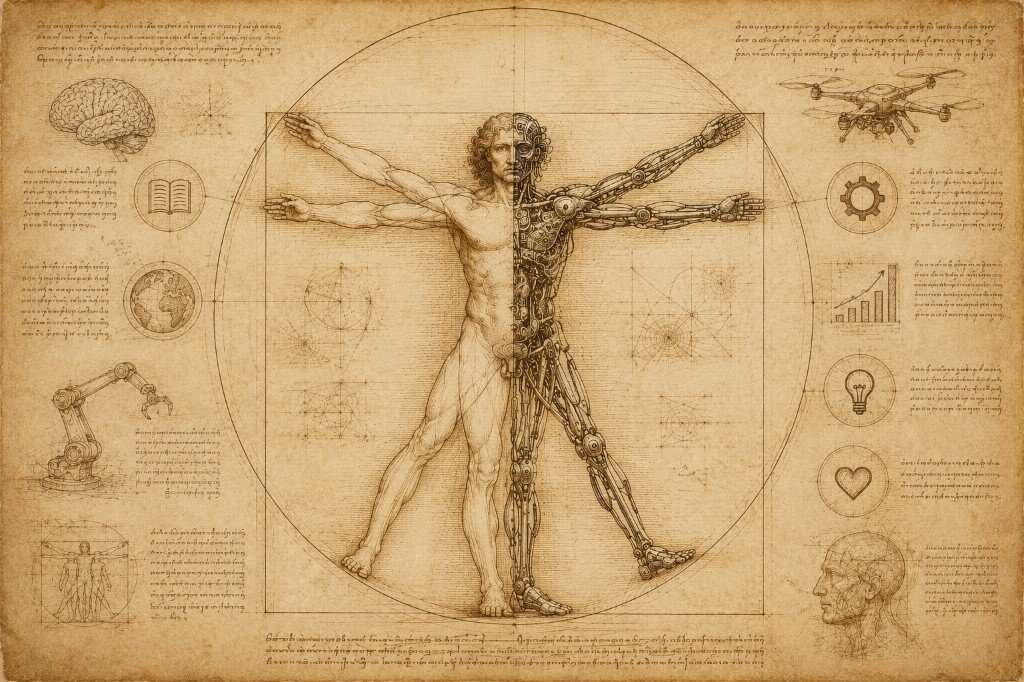
Walk into any room and ask about technology. You'll hear fear.
"AI will take our jobs."
"Kids won't learn anymore."
"We're losing human connection."
"The future doesn't look bright."
Then watch what people actually do.
They scroll for hours. They order food from apps. They ask ChatGPT before they ask a colleague. They work remotely, ride-share, home-share, and shop globally from their phone. We're terrified of technology—and we're completely addicted to it.
This isn't hypocrisy. It's a signal.
We sense that the old human model—work to survive, learn once, trust what you're told, depend on who you know—is breaking. What we haven't fully accepted is that the problem isn't technology. It's that our civilization's rules haven't caught up to reality.
Technology didn't invent fake news, unfair hiring, or economic desperation. It exposes them—and offers tools to fix them. The question isn't whether technology is good or bad. It's whether we'll adapt fast enough that nobody gets crushed in the transition.
Should We Blame Technology—or Our Business Model?
Every major technology wave looked scary at first.
Agriculture meant fewer farmers—but more food.
Factories meant fewer craftsmen—but new industries.
Computers meant fewer clerks—but new office jobs.
Each time, humanity eventually found a new place for people to contribute. This time feels different because the pace is faster and the replacement isn't obvious yet. AI and robotics can replicate not only muscle but much of what we call "knowledge work."
So fear is rational. But blame is misdirected.
Technology is a mirror. It shows that:
- Networking often beats merit
- Intermediaries multiply costs
- Work is tied to survival, not purpose
- Trust was convenient until it wasn't
Blaming technology for job loss is like blaming the plow for unemployed field hands. The real failure is not building a new economic and social model—one where security doesn't depend on obsolete jobs, learning is lifelong, and tools amplify humans instead of only replacing them.
If we adapt correctly, technology doesn't shrink humanity. It upgrades it.
How Human Networks Are Being Transformed
For centuries, human networking was the only way to access opportunity.
Need a house? Know someone who knows an agent.
Need a job? Know someone inside the company.
Need capital? Know someone who knows investors.
The chain was long. Each link took a cut. Access depended on who you knew—not what you could do.
The Old Network Economy
Advantages:
- Trust through relationships
- Insider access
- Speed when connections worked
Disadvantages:
- Jobs to connections, not the best candidates
- Prices inflated by intermediaries
- Outsiders without connections are excluded
- Dependence on others to succeed
Manufacturer → distributor → wholesaler → retailer → customer meant the final price could be 2× or 3× the real cost. Merit lost to connection. Fairness lost to privilege.
Technology Cuts the Chain
Platforms changed the equation:
- E-commerce: Manufacturer to customer
- Airbnb / Uber / Lyft...: Provider to user without traditional work chain
- LinkedIn / Indeed…: Candidate to employer without recruiters
- Crowdfunding: Builder to backer without the traditional investor
The shift: From connections to code. From "who you know" to "what you build."
This doesn't kill human relationships—it makes them optional and less transactional. You can still network. You don't "have" to network to eat, hire, sell, or learn.
For society, that means:
- More fairness (merit visible globally)
- Lower prices (fewer middlemen)
- More entrepreneurship (reach customers without an address book)
- More independence
Technology is disrupting human networking—and that's one of the biggest behavioral upgrades of our era. People can stop performing for others and start performing for their own reality. With technology, anybody can get better access to data, services or products for much less than what human network used to provide.
How Fast AI Is Turning Us Into "Super Humans"
If networking technology levels access, AI levels capability.
Who Resists—and Who Embraces
AI acceptance isn't random. It follows patterns tied to how people relate to knowledge:
Most resistant (initially):
- Knowledge professionals whose income depends on being the source of answers
- Strong "teacher" identities who gain status from knowing more than others
Most open:
- Individualists who want tools to learn and build faster without asking
- Low-wage workers excluded from degrees—AI democratizes expert-level information instantly
- Open-minded people who try tools and judge by results, not ideology
Here's the fascinating part: once people seriously try AI, resistance often collapses in a single session.
- "Wait, it can do that?"
- Skepticism becomes regular use
- Some even hide AI use to avoid admitting they were wrong publicly
The barrier isn't the technology. It's the first real try.
The Super-Human Effect
AI doesn't replace humans overnight in every task. It multiplies humans who learn to use it:
- A solo founder runs research, writing, code, and design at a pace that used to require a team
- A nurse checks protocols in seconds
- A student in a village accesses tutoring that once required an expensive school
- A mechanic diagnoses issues with AI-assisted documentation
We're not becoming obsolete. We're becoming augmented—if we accept the tool and forget our pride.
The future skill isn't memorizing facts. It's knowing how to use tools, verify output, and apply judgment. That's the new literacy—and children often learn it faster than older generations.
Knowledge professionals who adapt shift from information delivery to insight, mentorship, and judgment. Those who refuse may fight a losing battle against a tool too useful to ignore—even in secret.
Education and Knowledge: Humanity's Biggest Upgrade
The greatest gift of technology isn't a faster phone. It's universal access to information, services, and products in seconds.
Anyone with connectivity can:
- Learn a skill from free resources
- Compare prices globally
- Hear perspectives from other continents
- Test ideas before betting their life savings
The Fear of "Too Much" Content
Yes, there's noise. Fake content. Manipulation. Overwhelming volume.
Some people say: "It's too dangerous. People will believe anything."
But consider history. Fake content always existed—propaganda, rumors, biased textbooks, cherry-picked news. The difference is scale and speed, not existence.
The positive side of abundance: It makes us realize and forces a habit we should have had all along—verify the hard way.
In the past, we trusted quickly because sources were limited and gatekeepers seemed authoritative. That trust was often wrong. Wars, scams, and injustice rode on "trusted" information.
The future citizen:
- Less blindly trusting
- Checking sources
- Cross-referencing
- Looking paranoid to older generations—and that's a feature, not a bug
Expect your children to question almost everything. It will feel sad to those who miss the comfort of easy trust but it's good for civilization.
Education must shift from storage to navigation:
- How to find reliable data
- How to detect bias and fraud
- How to learn continuously (not 20 years school / 40 years work / 20 years rest)
- How to use tools—including AI—rather than memorize what tools already know
Anyone can access knowledge. Wisdom is the new scarcity. Technology improves behavior when it teaches verification, curiosity, and lifelong learning—not when it encourages passive consumption.
Productivity, Work, and Why UBI Becomes Inevitable
As machines and AI absorb more repetitive and cognitive labor, the need for humans working out of pure necessity diminishes. That scares people because today's model is simple:
- You work because you must
- You're lucky if you do what you love
- You earn 100 coins and return back 60/70 in taxes—considering all taxes paid back: sales tax, income tax, real estate tax, custom tax…
- Comfort is rare. Stress is normal.
Technology plus a proper safety net changes the equation.
Universal Basic Income: Security to Flourish
UBI isn't anti-work. It's anti-desperation.
When everyone has a secured minimum:
- People work for purpose, not only survival
- Entrepreneurship rises because failure isn't starvation
- Essential physical jobs can finally be paid fairly (when no one is forced to take them out of despair)
- Innovation accelerates because fear shrinks
Future generations may look at "work as we know it"—trading most of our life for basic security—and call it closer to slavery than freedom, especially for those with no margin and no choice.
Technology handles efficiency. UBI handles dignity during transition. Together, they allow performance driven by meaning:
- Earth cleaning at planetary scale
- Care work valued properly
- Art, science, and community projects without ROI-only filters
- Human effort where humans matter most
At O International, we've been building toward this future—a water price-based stablecoin and blockchain model designed to support universal basic income. Technology enables the tools; UBI enables the courage to use them.
Individualism—in the Good Sense
Technology pushes us toward a world that "looks" more individualist:
- Remote work
- Solo creators with global audiences
- Gig and platform economies
- AI-assisted one-person "companies"
Individualism doesn't mean selfish or greedy, and we shouldn't fear it.
Real individualists:
- Prefer learning by doing
- Rarely need help or hand-holding
- Spend years trying, failing, and hopefully finally succeeding
- Build independence and freedom without begging networks
And here's the paradox observed again and again: when independent builders succeed, they often become highly generous—not in empty talk, but in real output to all.
- Open-source developers
- Creators who share knowledge freely to all
- Entrepreneurs who ship products everywhere
They don't need you to need them. They offer value because they cut the chain.
Technology Levels the Entrepreneurial Field
Going through humans for everything adds delay, politics, and cost.
Big corporations once won because they owned distribution, legal teams, and capital access. Now:
- Cloud tools replace IT departments
- AI replaces chunks of agency work
- E-commerce Platforms replace shops
- Universal knowledge replaces the old degree
Any motivated person on earth can access world-class tools. That's not destruction of opportunity—it's the widest spread of opportunity in history.
The hope for the future isn't everyone working for giants. It's millions of small builders taking calculated risks—because the field is finally level.
Ride-sharing and home-sharing were early signals: workers choosing their pace outside the classic employer-employee relation. AI is the next multiplier.
Respect, Independence, and the Path to Peace
Much disrespect in the world comes from dependency.
- Financial dependency breeds resentment
- Countries dependent on imports for essentials get pressured
- Employees trapped in bad jobs accept humiliation
- Networks exploit because you can't leave or talk
Technology reduces dependency:
- More people can produce, learn, and trade with less permission
- Nations can approach self-sufficiency in energy, food tech, manufacturing knowledge, and digital services
- Individuals rely less on a single employer or patron
When you need someone less, you can respect them more!
Respect isn't politeness. It's the ability to treat others as equals because neither side holds survival hostage.
Scale that up:
- Less economic blackmail between countries
- Less desperation migration driven only by currency collapse
- More room for cooperation instead of control
Peace doesn't come from everyone loving each other overnight. It grows when parties aren't starving, trapped, or owned. Technology—combined with fair systems like UBI and direct access to value—moves us in that direction.
Our Children Know More Than We Did at Their Age—And That's a Skill
Older generations often mock young people for being "always on their phones." But many children understand technology faster than adults because they're not defending an old identity tied to being the expert.
They're growing up in a world where:
- Verification is normal
- Tools change every few years
- Learning never stops
- Adaptation is survival
The behavioral curve isn't linear. It's exponential. Parents who dismiss this will be outpaced—not because children are smarter, but because they're less attached to how things used to work.
That's uncomfortable. It's also hope.
Technology Is Not the End of Civilization—It's the Tool to Save It
Summing up what technology can improve—if we adapt:
- Networks: From who you know → to what you build
- Work: From necessity → to purpose (with UBI security)
- Knowledge: From gatekept → universal (with verification habits)
- Capability: From solo human limits → AI-augmented "super humans"
- Economy: From intermediary-heavy → direct, cheaper, fairer access
- Society: From dependency and disrespect → independence and respect
- Peace: From resource hostage games → more self-sufficiency
The negatives are real: job displacement, misinformation, addiction, inequality during transition.
The positives are larger—but only if we implement the social layer: UBI, lifelong education, fair access, and systems that don't recreate old networks in digital form.
Technology provokes massive behavioral change. Our job isn't to stop it. It's to govern the transition with wisdom so no one is left behind.
Fear says: technology will end us.
History says: refusing to adapt ends civilizations—not tools.
Addiction says: we already depend on it.
Honesty says: let's redesign the rules to match reality.
Interested in Solutions for the Future?
If this resonates, we're building practical answers—not just theory.
O International explores how programmable, water price-based money and blockchain infrastructure can support:
- Reverse immigration
- Universal Basic Income mechanisms
- Financing vital work—including earth cleaning—when ROI alone won't pay for it
Technology is the engine. Adaptation is the steering wheel.
Visit us to learn more about solutions for the transition ahead.