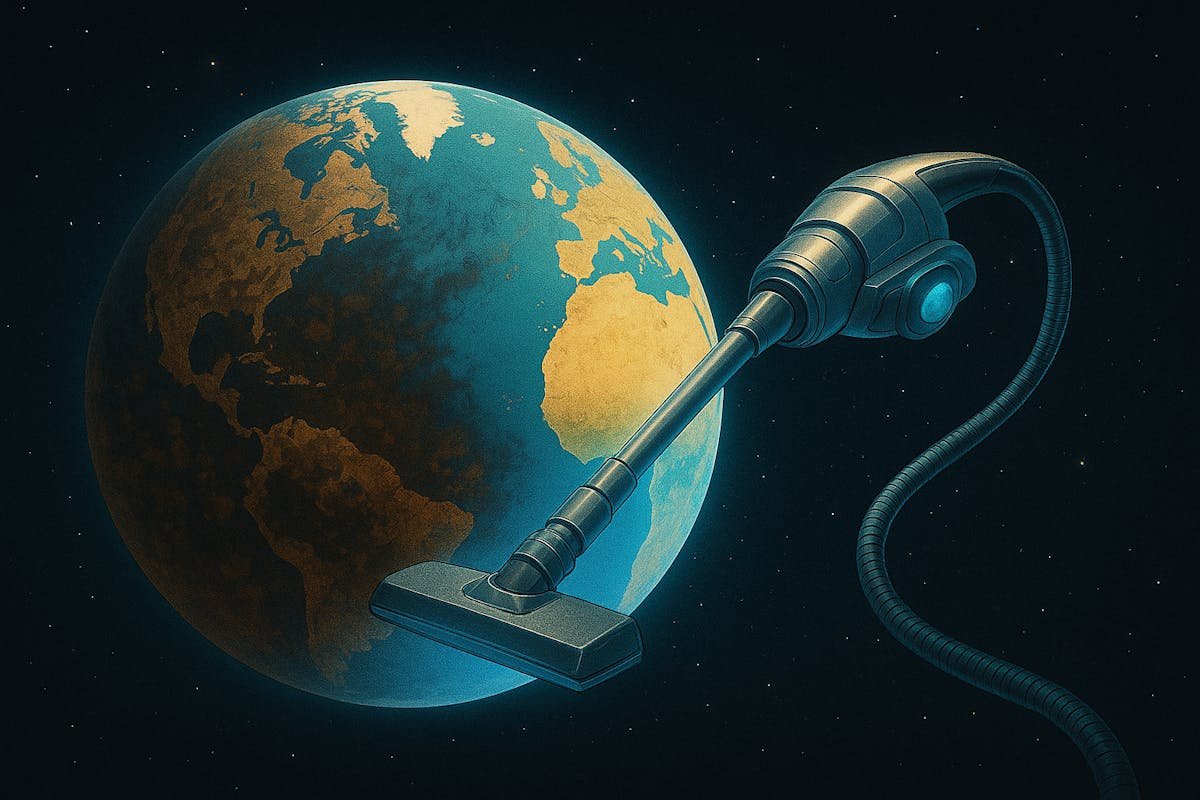
The Paradox: We Can Clean Earth, But We Don't
Imagine if you could reverse decades of pollution. Remove billions of tons of CO₂ from the atmosphere. Clean millions of square kilometers of ocean. Restore forests at scale. The good news? We can. The bad news? We're not doing it fast enough.
The technologies exist. Research is advancing. But deployment is crawling. Why? Because cleaning Earth doesn't generate Return On Investment (ROI). It's not profitable. And in a world where everything needs to make financial sense, planetary cleanup gets deprioritized.
Let's examine where we actually stand with earth-cleaning technologies at the end of 2025.
1. Carbon Capture: From Lab to Scale (But Not Fast Enough)
Direct Air Capture (DAC)
Current Status: Operational but expensive
DAC technology pulls CO₂ directly from ambient air. Companies like Climeworks, Carbon Engineering, and Global Thermostat have operational facilities.
2025 Reality:
- Climeworks' Mammoth plant (Iceland): Launched in 2024, can extract 36,000 metric tons/year—almost ten times the capacity of its predecessor Orca plant (Iceland). [Source: Reuters, May 2024]
- Carbon Engineering (Canada): Building facilities for large-scale capacity
- Global Thermostat (USA): Modular systems, targeting cost reductions by 2030
- Current DAC costs: Estimates range from $200–1,900 per metric ton, depending on technology and scale. [Sources: IEA, Science Daily, various industry reports]
- Projected costs: Companies aim for $200–600/ton by 2030, $200–350/ton by 2040
The Problem: We need to capture billions of tons/year by 2050 to meet climate goals. Current global DAC capacity? Approximately 50+ million tons/year from all carbon capture facilities combined (including point-source capture). [Source: IEA, 2023] The technology works, but scaling requires massive capital - capital that doesn't generate returns.
R&D Progress:
- ✅ Efficiency improving: Energy requirements decreasing
- ✅ Cost reduction: From over $1,000/ton to $200–600/ton range (projected)
- ⚠️ Still too expensive for mass deployment without subsidies
- ⚠️ Storage solutions (geological, mineralization) advancing but limited
Bioenergy with Carbon Capture and Storage (BECCS)
Current Status: Pilot projects operational
BECCS combines biomass energy production with carbon capture. The UK's Drax power station is testing this at scale.
2025 Reality:
- Drax BECCS (UK): Capturing 2 million tons/year by 2030
- Challenges: Land use conflicts, biomass supply chain issues
- Potential: Could remove 5–10 billion tons/year if scaled globally
The Problem: Requires vast agricultural land. Competing with food production. Not economically viable without subsidies.
Enhanced Weathering & Ocean Alkalinity Enhancement
Current Status: Early research phase
Spreading minerals (olivine, basalt) to accelerate natural CO₂ absorption. Ocean alkalinity enhancement adds alkaline materials to seawater.
2025 Reality:
- Research: Promising lab results, field trials ongoing
- Cost: Potentially $50–200/ton if scaled
- Risk: Unknown environmental impacts at scale
- Timeline: 5–10 years to prove viability
2. Ocean Cleanup: Plastic Removal at Scale
The Ocean Cleanup Project
Current Status: System 03 deployed, removing plastic from Great Pacific Garbage Patch
Boyan Slat's Ocean Cleanup has evolved from concept to operational system.
2025 Reality:
- System 03: 2.4 km long barrier, capturing plastic autonomously
- Progress: Removed 200,000+ kg of plastic from GPGP
- Goal: Remove 90% of ocean plastic by 2040
- Cost: $200–300 million for full-scale deployment
The Problem: Even at full scale, it addresses symptoms, not sources. Most plastic enters oceans from rivers. The Interceptor (river cleanup) helps, but 1,000 rivers need cleanup. Funding? Limited.
R&D Progress:
- ✅ Autonomous systems working
- ✅ Plastic recycling from ocean waste improving
- ⚠️ Microplastics removal still experimental
- ⚠️ Cost per ton removed: $4,000–6,000 (not profitable)
Microplastics Removal
Current Status: Research phase, no large-scale solutions
Microplastics are everywhere: oceans, soil, air, human bodies. Removal technologies exist but aren't deployed.
2025 Reality:
- Filtration systems: Lab-scale success, not scaled
- Bioremediation: Bacteria that eat plastic—promising but early stage
- Magnetic separation: Works in controlled environments
- Challenge: Removing microplastics from open ocean? Nearly impossible at scale
3. Reforestation: Drones, Bioengineering, and Scale
Drone Reforestation
Current Status: Operational, scaling up
Companies like Dendra Systems, DroneSeed, and Flash Forest use drones to plant trees at unprecedented speeds.
2025 Reality:
- Dendra Systems: Planting hundreds of thousands of trees/day with drone swarms
- Flash Forest: 1 billion trees by 2028 target
- Cost: $0.50–2.00 per tree (vs $2–5 manual planting)
- Success rate: 70–80% survival (improving)
The Problem: We need trillions of trees to offset current emissions. At current rates? Decades or centuries. We need much faster deployment. But who pays for 1 trillion trees? No ROI.
R&D Progress:
- ✅ Seed pod technology improving survival rates
- ✅ AI mapping for optimal planting locations
- ✅ Native species selection algorithms
- ⚠️ Still too slow for climate timeline
Bioengineered Trees
Current Status: Research phase
Genetically modified trees that grow faster, capture more CO₂, or resist climate stress.
2025 Reality:
- Living Carbon: Fast-growing poplar trees, 50% more carbon capture
- Research: Trees with enhanced root systems, drought resistance
- Challenges: Regulatory approval, ecological concerns, public acceptance
- Timeline: 5–10 years to deployment
4. Air Pollution Control: From Cities to Global Scale
Industrial Air Purification
Current Status: Deployed at industrial scale
Scrubbers, filters, and catalytic converters remove pollutants from industrial emissions.
2025 Reality:
- China: Installed scrubbers on majority of coal plants (2014–2020)
- India: Retrofitting hundreds of power plants
- Cost: $100–500 million per large plant
- Result: Air quality improving in major cities
The Problem: Developing countries can't afford retrofits. 2,000+ coal plants worldwide still need cleanup. No funding.
Direct Air Pollution Removal
Current Status: Urban installations, limited scale
Large-scale air purifiers in cities (like Smog Free Tower in China, Netherlands).
2025 Reality:
- Smog Free Tower: Removes significant volumes of air, captures PM2.5 particles
- Cost: $50,000–200,000 per tower
- Scale: Need millions of towers globally
- Challenge: Energy intensive, expensive to operate
5. Soil Remediation: Cleaning Decades of Contamination
Phytoremediation
Current Status: Deployed for specific sites
Using plants to absorb and break down soil contaminants.
2025 Reality:
- Success stories: Sunflowers removing radiation (Chernobyl), willows cleaning heavy metals
- Limitations: Slow (years), site-specific, not scalable for global contamination
- Cost: $10–50 per ton of soil (cheap but slow)
Chemical & Biological Remediation
Current Status: Operational for industrial sites
Injecting chemicals or bacteria to break down contaminants.
2025 Reality:
- In-situ remediation: $50–500 per ton
- Ex-situ (excavation): $100–1,000 per ton
- Scale: Millions of contaminated sites globally
- Funding: Limited to high-value land (not agricultural or remote areas)
6. Renewable Energy Transition: The Foundation
Current Status: Accelerating but not fast enough
Solar, wind, and battery costs have plummeted. Deployment is accelerating.
2025 Reality:
- Solar: $0.03–0.05/kWh (cheaper than fossil fuels)
- Wind: $0.03–0.06/kWh
- Battery storage: $100–150/kWh (down 90% since 2010)
- Deployment: Hundreds of GW added annually (need much more to meet climate goals)
The Problem: Transitioning global energy system requires $4–5 trillion/year. Current investment? $1.5 trillion/year. Gap? $2.5–3.5 trillion/year. Where does it come from? Debt? Taxes? Not sustainable.
The Funding Gap: Why R&D Isn't Advancing Enough
Here's the brutal truth: We have the technologies. We don't have the funding model to deploy!
Current Funding Sources (All Limited)
- Government Debt: $100+ trillion needed. Can't borrow that much.
- Taxes: Politically impossible. No country will tax enough.
- Private Investment: Requires ROI. Earth cleaning doesn't generate returns.
- Carbon Credits: $2–50/ton. Not enough to fund deployment.
- Philanthropy: Billions, not trillions. Insufficient scale.
The Math
- Carbon capture: $100–600/ton × billions of tons needed = trillions/year
- Ocean cleanup: Hundreds of billions one-time + tens of billions/year operations
- Reforestation: Hundreds of billions one-time + tens of billions/year maintenance
- Air pollution: Trillions for global retrofits
- Soil remediation: Trillions (depending on scale)
- Renewable transition: Trillions/year
Total: Trillions per year for decades = hundreds of trillions total.
Current global GDP: Approximately $100 trillion/year (2024–2025 estimates). We'd need to allocate a significant percentage of global GDP to earth cleaning. Challenging with current economics.
The Solution: Programmable Money for Planetary Cleanup
This is where programmable money changes everything. The O Coin system—a water-based stable currency with unlimited supply—could fund earth cleaning at scale without debt, taxes, or ROI requirements.
How It Works
- Unlimited Supply: O Coin isn't backed by physical assets. It's calibrated to water prices. Can create unlimited money for public good without creditors while staying strong and stable. Read more at https://o.international
- No ROI Required: Projects don't need to be profitable. They just need to be performant in cleaning Earth. O Coin enables this by keeping the currencies stable independently of human or government trust. Return value should be measured by deliveries and performance rather than pure financial return.
- Transparent Tracking for Auditing: Blockchain records all funding and outcomes. Everyone sees where O goes and what it achieves.
The Impact
- Carbon capture: Funded at scale, not limited by profitability
- Ocean cleanup: Full deployment, not just pilot projects
- Reforestation: 1 trillion trees in 10 years, not 200
- Air pollution: Global retrofits, not just rich countries
- Soil remediation: All contaminated sites, not just valuable land
The technologies are ready. The funding model isn't. O Coin fixes that.
Conclusion: We're Not Losing Because of Technology but Because of Finance
Earth cleaning technologies are advancing. R&D is progressing. But deployment is crawling because traditional economics can't fund planetary-scale cleanup.
We need a new funding model. One that doesn't require ROI. One that doesn't create debt. One that enables unlimited deployment of proven technologies based on performance for public goods.
The O Coin system provides that. Water-based calibration. Unlimited supply. Democratic allocation. Transparent tracking. Open Source.
The question isn't whether we can clean Earth. We can. The question is: Will we fund it?
With programmable money for public good, the answer becomes: Yes. We will.
Learn more about our project at https://o.international
References & Further Reading
- Climeworks: Direct Air Capture Technology
- The Ocean Cleanup: System 03 Deployment
- Dendra Systems: Drone Reforestation at Scale
- Living Carbon: Bioengineered Trees for Carbon Capture
- O Blockchain: Water-Based Currency for Public Good